Translate driver-assistance names into warnings, interventions and driver duties
A branded assistance package can contain several functions with different limits. A warning is not the same as automatic intervention, and either can still require continuous driver attention. A useful comparison maps what the exact vehicle does, when it operates and what the driver remains responsible for.
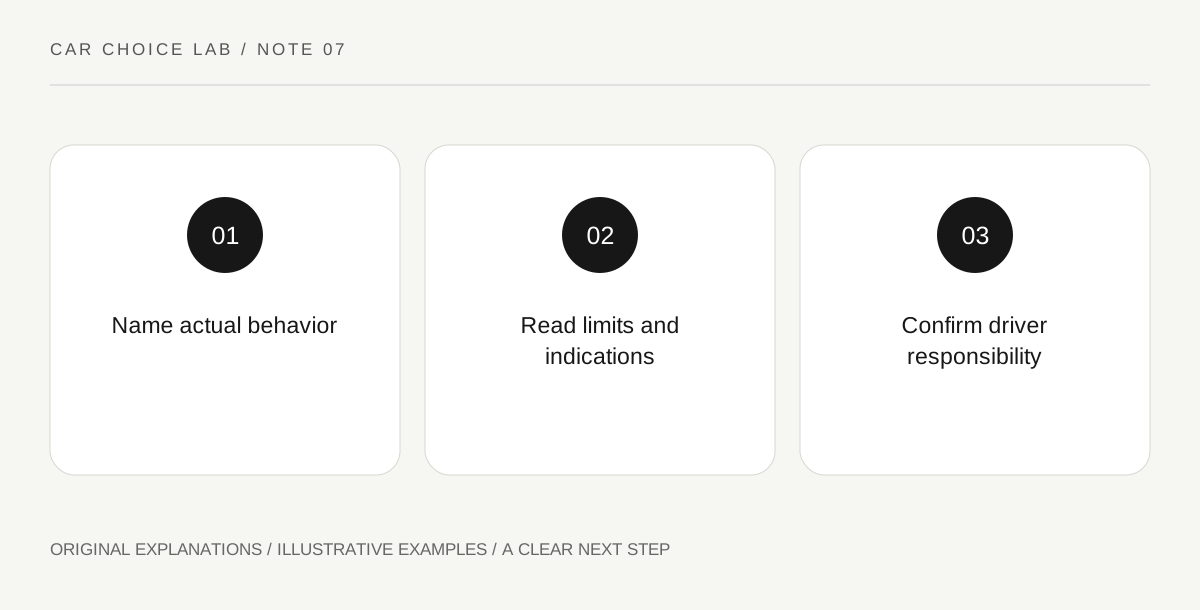
Original explanatory diagram. Read the full method and limitations below.
Write the function in ordinary language
Use NHTSA's technology descriptions to distinguish a warning from an intervention. A lane-departure alert, steering assistance and a system combining speed and steering support do not all do the same thing. Keep the manufacturer's exact name beside the plain-language description. Marketing terms can differ across brands and model years. Do not infer automation level from a futuristic name or a dashboard image. The question is what the actual car is designed to do in the stated conditions, not how independent the package sounds. Keep every essential function tied to the vehicle's documented equipment.
Read conditions and limits in the manual
Ask about road types, lane markings, weather, sensors, speed ranges and other operating conditions relevant to the system. The exact limits vary, so this article does not provide one universal table. A function may be unavailable or behave differently outside its intended conditions. Read how the car indicates engagement, disengagement and a request for driver action. Do not assume a green symbol means the vehicle will handle every hazard. Ask for a clear stationary explanation of the interface before driving. If software or a subscription affects access, verify current terms for the exact vehicle and account.
Keep responsibility explicit
NHTSA distinguishes assistance from higher levels of automation and emphasizes driver responsibility for current assistance systems. Do not use a feature name as permission to look away, use a phone or leave the driving position. Follow the manual and road rules. A camera or steering-wheel prompt does not turn an unsafe distraction into an acceptable experiment. If you are unsure what supervision is required, resolve that before using the function. The shopping comparison should favor understandable duties and limits rather than the largest list of acronyms. A system can be useful while still requiring active attentive driving.
Ask how the vehicle communicates that a function is unavailable. A driver who understands the feature name but not its status display can still misunderstand what is active. Learn the relevant indications while parked and read the manual. Do not assume that a familiar icon has the same meaning in every car. A clear interface explanation should include both normal operation and the point at which the driver must recognize a change.
Compare real usability without hazardous tests
Ask how settings are accessed, how alerts are presented and what happens after restarting the vehicle. Use permitted safe demonstrations and manufacturer information, not a deliberate near-collision or lane departure in traffic. Record whether the exact feature is fitted and whether any issue remains unresolved. A test drive may reveal interface preferences but cannot validate every operating condition. Keep safety ratings, recalls and assistance functions as related but distinct evidence. The useful outcome is a clear function map with limits and duties, not a claim that a package makes one car self-driving or eliminates the need for careful road behavior.
An illustrative function map
A buyer sees two differently branded lane packages. She records whether each warns, provides steering assistance or combines functions, then reads the exact operating limits and driver duties. She does not compare the names alone or intentionally drift out of a lane to test them during a sales drive.
Practical checks
Optional checkboxes save only in this browser.
Questions that come up
Does steering assistance mean self-driving?
Do not assume so. Read the exact system's capability and driver responsibilities in official information.
Can a test drive verify every limitation?
No. It is a limited sample and should never involve creating hazards to provoke a system.
References and scope
These sources support the factual background. Examples and exercises are original illustrative teaching material. References do not imply endorsement.
- NHTSA: Driver Assistance Technologies — Warning versus intervention functions and driver responsibility.