Check the exact VIN for recalls and read the remedy instructions
A model-level recall story does not tell you whether the car being offered has an open recall or what its owner should do. A useful check uses the exact vehicle identity, the official result and current remedy information. It also keeps a recall search separate from a complete condition assessment.
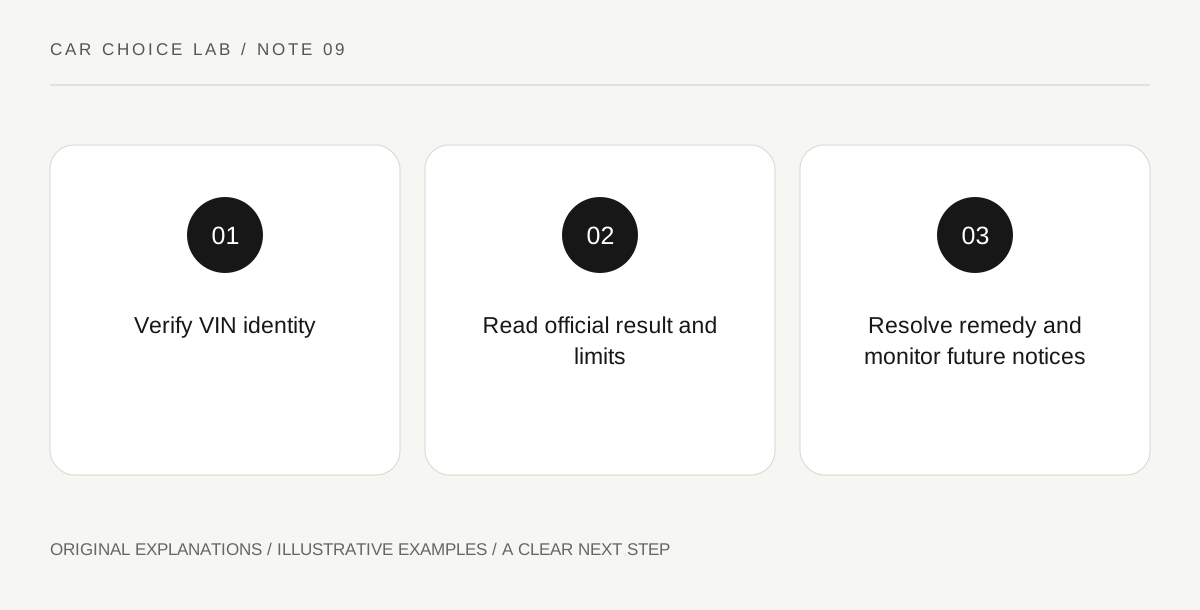
Original explanatory diagram. Read the full method and limitations below.
Match the VIN to the vehicle and records
Use the VIN from the actual car and compare it with the relevant documents and listing. Resolve a discrepancy before proceeding. Do not rely on a copied number from another advertisement or a model name alone. NHTSA provides a recall lookup for specific vehicles, with stated limitations. Record the search date and source so a later review is understandable. Keep the number private where appropriate and do not post personal registration information unnecessarily. A basic VIN identity check supports the search, but it does not establish ownership, title status or the accuracy of every sales statement.
If the seller provides repair paperwork, check that it identifies the correct VIN and campaign rather than only a generic service visit. Ask the authorized provider to clarify an ambiguous record. A routine maintenance invoice does not automatically demonstrate that an open recall remedy was completed. Keep the official lookup and completion information dated, because new campaigns can be announced after a prior repair or search. Ongoing ownership monitoring remains a separate task.
Read the result and its limits
An open recall result identifies a safety issue requiring attention under the applicable remedy process. Read the actual campaign information rather than only the count. A result showing no unrepaired recalls is not a certificate that the car is mechanically sound or that every historical issue is absent. NHTSA explains limitations of the lookup, including information that may not appear. Keep uncertainty visible and ask the manufacturer or authorized service provider when needed. Do not interpret a blank or failed search as a clean result. A technical error needs resolution, not a favorable assumption.
Follow the current action and remedy information
Check whether the notice includes special instructions, such as restrictions or an urgent action. Follow the official guidance for that exact recall rather than a generic article. Ask the manufacturer or authorized repair provider about remedy availability and completion records. Do not assume a seller's statement that it will be handled is equivalent to documented completion. If a repair is not yet available, understand what that means for the purchase and use decision. This site cannot declare a particular vehicle safe to drive. The official notice and qualified service advice govern the specific action.
Keep recall monitoring in ownership planning
A pre-purchase search is a dated check. Consider the official alert options and keep manufacturer contact information current if you buy. Save completion documentation alongside the vehicle's records. Continue maintenance and any independent inspection process; recall remedies address defined issues rather than every possible fault. Avoid judging a brand only by a raw recall count without context, because campaigns differ in scope and severity. The useful outcome is a clear answer about this vehicle's current recall status and next action, with the search's limits understood. It is not a guarantee of reliability or a substitute for title and mechanical checks.
An illustrative recall follow-up
A shopper searches the actual VIN and finds an open campaign. She reads the current notice and asks an authorized provider about the remedy and completion documentation. She does not treat a model-level news article or a seller's verbal promise as the final answer, and keeps the purchase decision open until the issue is understood.
Practical checks
Optional checkboxes save only in this browser.
Questions that come up
Does no open recall prove good condition?
No. It is a limited recall result. Mechanical condition, title history and maintenance need separate checks.
Should I follow a generic recall summary?
Use the current official notice and manufacturer guidance for the exact campaign and vehicle.
References and scope
These sources support the factual background. Examples and exercises are original illustrative teaching material. References do not imply endorsement.
- NHTSA: Recall Search — Vehicle-specific recall lookup, limitations and remedy information.
- NHTSA: Vehicle Product Information Catalog — Basic VIN decoding based on manufacturer-submitted information.