Read a safety rating with its test, model year and comparison limits
A star rating is useful evidence only when attached to the correct vehicle and test. It is not a guarantee for every crash or a universal ranking across all vehicle sizes. A careful comparison reads categories, notices and the program's rules before turning a result into a purchase conclusion.
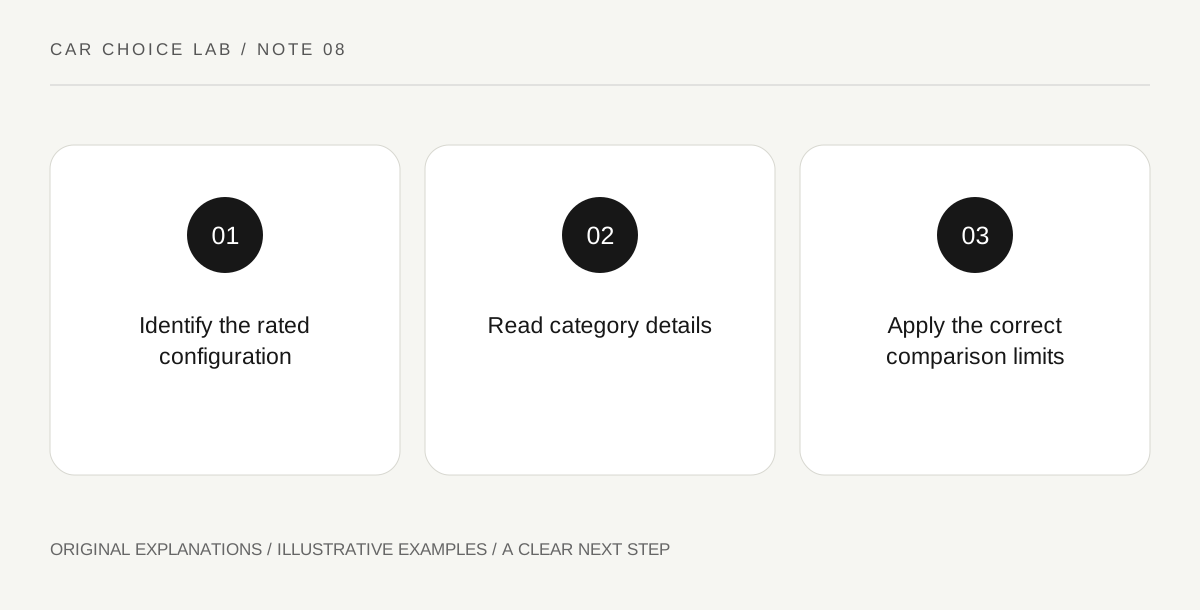
Original explanatory diagram. Read the full method and limitations below.
Find the exact rated vehicle
Use the model year, body style and other relevant configuration details specified by the rating program. A redesign or another version may have different results. Keep not rated distinct from a low rating; absence of a test does not by itself establish performance. NHTSA provides vehicle-specific results and explanations of its tests. Do not copy a score from a similarly named car in another market or year. If the result has an applicability note, read it. The rating is a statement about the tested scope, not a transferable badge for every vehicle carrying the same brand.
Read the test categories separately
NHTSA evaluates frontal, side and rollover performance. The overall result combines information, while individual categories can reveal distinctions. Read any safety-concern notice rather than looking only at the stars. The agency explains that a vehicle can have a high rating while a specific concern is noted. Keep the categories attached to your notes. A frontal result should not silently stand for every possible collision. Different organizations can use different tests and scoring systems, so do not average unlike ratings into a new scientific-looking score without a defensible method.
Respect the comparison rules
NHTSA states that frontal crash ratings should be compared within the same vehicle class and a specified weight range, because the test represents a collision between similar-weight vehicles. Other categories have different comparison rules. Read the current program explanation rather than assuming all stars are directly interchangeable. The point is not that cross-size shopping is impossible; it is that one result has a defined meaning. Keep vehicle size, use needs and other safety information in view without converting the star symbol into a claim that a smaller or larger car guarantees a particular outcome in every real-world event.
Combine evidence without overclaiming
Review recalls, equipment and appropriate child-restraint or occupant needs alongside crash-test information. An assistance package is not the same evidence as a crash rating, and a recall search is not a mechanical inspection. Keep those questions separate enough to identify what remains unknown. Safety is a legitimate priority, but no rating eliminates risk or replaces attentive driving, maintenance and restraint use. The useful conclusion can be modest: the exact vehicle has these published results under these tests, with these notes. That is more informative than declaring a universally safest car from one number.
Keep the rating program's date and methodology attached when comparing across years. A newer test or revised criterion can change what an award or score represents. Do not assume an identically named award always uses an unchanged method. Read the current program notes and the exact result rather than relying on a badge in an old advertisement. The source can support a specific conclusion without becoming a complete forecast of real-world crash outcomes.
An illustrative rating comparison
A buyer records the exact model years of two candidates and reads NHTSA's category results and comparison rules. She notices a safety-concern symbol that the overall stars alone would not explain. She keeps that issue in the decision rather than averaging the result with an unrelated rating program.
Practical checks
Optional checkboxes save only in this browser.
Questions that come up
Does not rated mean unsafe?
It means the particular rating is unavailable, not a measured low result. Seek other appropriate evidence without inventing a score.
Can I compare every frontal star result directly?
No. NHTSA specifies class and weight limits for frontal comparisons. Read the current explanation for the exact category.
References and scope
These sources support the factual background. Examples and exercises are original illustrative teaching material. References do not imply endorsement.
- NHTSA: Vehicle Safety Ratings — Test categories, comparison limits and safety-concern notices.