Use a vehicle-history report as a record source, not a mechanical all-clear
A vehicle-history report can reveal important information while still leaving gaps. The useful question is what the report includes, where the information comes from and what separate checks remain. A clean-looking page does not replace an independent inspection or prove that every event in the car's life was recorded.
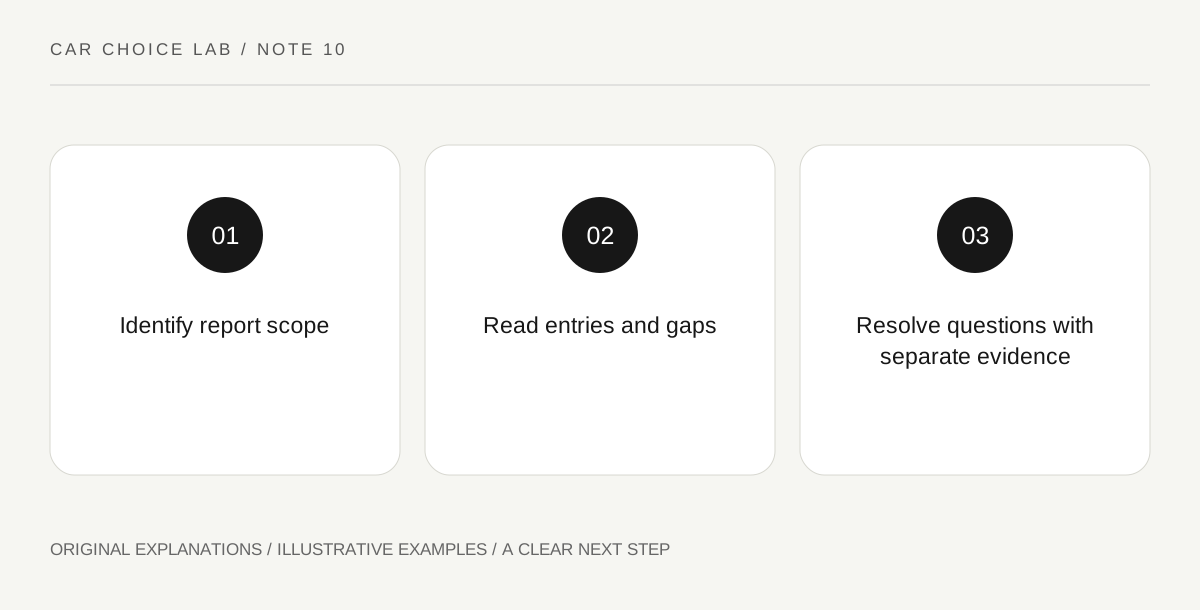
Original explanatory diagram. Read the full method and limitations below.
Identify the report and its scope
Record the provider, VIN, date and data system involved. The U.S. Department of Justice describes NMVTIS consumer reports and approved providers, with a disclaimer about what is and is not included. Different products can add other information, so do not assume all reports have identical coverage. Read the actual scope instead of relying on a badge that says history checked. A report is a dated view of available records. If the VIN does not match the vehicle, stop and resolve that discrepancy before interpreting any favorable detail.
Read significant entries in their original context
Look at title brands, odometer information and other reported events with the definitions supplied by the source. Do not turn a shorthand entry into a complete story about the severity or quality of a repair. Ask for relevant documentation and appropriate professional interpretation. A title term can have jurisdiction-specific meaning, so use the issuing authority's current information where necessary. Keep missing details missing. A seller's explanation may be useful to investigate, but it is not automatically independent confirmation. The aim is understanding what the record actually establishes and which question it raises.
Keep the report file rather than only a favorable summary screenshot. Scope notes, dates and definitions can be lost when a result is cropped to one green badge. If a later question arises, the full context makes it easier to see what was actually available at purchase time. Avoid interpreting a subsequent updated report as proof that an earlier reader deliberately hid information without investigating the timing and source.
Keep absence of a record distinct from absence of an event
Not every repair, collision or problem necessarily appears in a report. A report without a concerning entry cannot establish that the vehicle has never been damaged. FTC advice recommends an independent inspection even when a history report is available. Keep those checks complementary: records can identify questions for the inspector, while the physical inspection addresses condition within its own scope. Do not ask a report to predict every future repair or a mechanic to certify title history from appearance. Each source has a different job and its own limits.
Use unresolved findings in the purchase decision
If a significant issue cannot be explained or verified, keep the decision open or decline the candidate. You do not need to prove fraud to decide the uncertainty does not fit your needs. Ask for promises and relevant terms in writing, and follow appropriate consumer or legal routes for a serious concern. Avoid publishing accusations based on an ambiguous report entry. The useful conclusion is specific: these records are available, these points are confirmed and these questions remain. That gives a stronger basis for comparison than either rejecting every used car with a history or treating one clean page as a guarantee.
An illustrative report review
A report lists an event without enough detail to explain the repair. The buyer asks for documentation and gives the entry to an independent inspector as a question. A second report with no entry would not prove that nothing happened. The buyer keeps title records and physical condition as separate evidence.
Practical checks
Optional checkboxes save only in this browser.
Questions that come up
Does a clean report prove no previous damage?
No. Some events may not be recorded. Treat the report as one source with stated limits.
Can a history report replace a mechanic?
No. Record history and physical condition are different questions, each needing appropriate evidence.
References and scope
These sources support the factual background. Examples and exercises are original illustrative teaching material. References do not imply endorsement.
- U.S. DOJ NMVTIS: Consumer Information — Title-history reports, approved providers and limitations.
- FTC: Buying a Used Car from a Dealer — Buyers Guide, independent inspections, warranties and used-car shopping.