Read payload and towing limits for the actual configuration, not the largest advertisement
A maximum towing headline may apply to a particular configuration that differs from the vehicle on the lot. Payload, passengers, cargo and trailer-related loads also interact. A useful shopping check uses the exact vehicle's labels, manual and manufacturer guide, with qualified advice rather than a single capacity number.
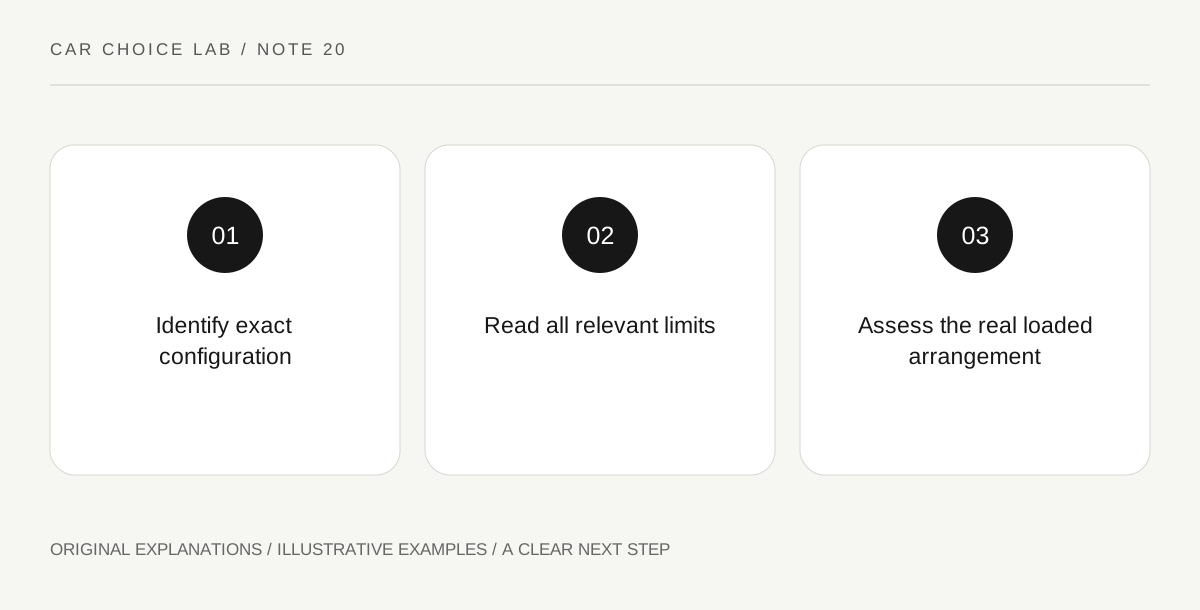
Original explanatory diagram. Read the full method and limitations below.
Identify the complete vehicle configuration
Record model year, powertrain, body, drivetrain and any relevant towing package or other manufacturer-specified factor. Ford's published towing guides illustrate why a manufacturer source must be matched to the correct year and configuration; this is not a recommendation of that brand. Use the equivalent official information for the vehicle you are considering. A hitch receiver or tow-mode button does not establish the full rated capability. Ask for documentation of installed equipment and any modifications. Keep the advertised up-to figure separate from the rating that actually applies. If the configuration cannot be resolved, the capacity question remains unanswered.
Keep payload distinct from trailer rating
Passenger and cargo loads affect the vehicle, and trailer-related loads can also count in ways explained by the manufacturer's guidance. Read the actual tire and loading label and manual rather than subtracting from a generic brochure figure. NHTSA's loading and tire resources point to vehicle-specific information. This article does not provide a universal towing formula or certify a combination. Different limits can apply to the vehicle, axles, hitch, tires and trailer. A large number in one category does not cancel a lower limit elsewhere. Ask a qualified professional to explain the relevant constraints for your intended setup.
Describe the real loaded use
Use the trailer or carried equipment's actual relevant weights and configuration, including supplies and passengers, rather than an empty headline weight alone. Follow manufacturer definitions and seek appropriate measurement or specialist help. Do not guess a safe load from appearance or assume a short trip permits exceeding a limit. Loading and securing also require suitable equipment and technique. A roof carrier, hitch carrier or trailer can change the practical arrangement beyond cargo volume. The shopping task should establish whether the intended use is appropriate before purchase, not leave a serious compatibility question for the first loaded journey.
Compare with room for the full arrangement
Ask about required equipment, maintenance, operating instructions and any local legal requirements for the actual use. Obtain current official information rather than treating another owner's setup as proof. Include the cost and availability of compatible components in the purchase comparison. Do not assume an aftermarket addition raises a manufacturer's rating. If the intended task is rare, consider appropriate alternatives while keeping safety central. The useful outcome is a documented, configuration-specific answer with all relevant limits understood. It is not a claim that a powerful engine, large body or impressive advertised maximum makes every load suitable.
Read definitions before using a limit in a calculation. A manufacturer's maximum figure may rely on specific equipment and assumptions, while the label on the actual vehicle reflects its configuration. If the terms or interaction are unclear, ask a qualified specialist to explain them using the intended load. Avoid an internet calculator that silently substitutes generic values for missing information. A conservative-looking result is not reliable when the inputs describe another vehicle.
An illustrative configuration check
A shopper sees a high towing headline but finds that the actual vehicle lacks the configuration used for that figure. She gathers the correct manual, loading label and manufacturer guide, then asks a qualified professional about the intended loaded trailer and passengers. She does not infer capacity from the presence of a hitch alone.
Practical checks
Optional checkboxes save only in this browser.
Questions that come up
Does adding a hitch increase the vehicle's rating?
Do not assume so. Compatibility and manufacturer limits still apply. Verify the actual arrangement.
Can an empty trailer weight settle the question?
No. The intended loaded combination and all relevant limits need to be considered using manufacturer guidance and appropriate expertise.
References and scope
These sources support the factual background. Examples and exercises are original illustrative teaching material. References do not imply endorsement.
- NHTSA: TireWise — Vehicle-specific tire and loading information and maintenance needs.
- Ford: Towing Guides — Example of a manufacturer source for model-year and configuration-specific towing information; not a brand recommendation.