Write a car brief from an ordinary week and the trip that genuinely changes it
A car can be excellent for an imagined lifestyle and awkward for the journeys you actually make. A useful brief starts with normal trips, passengers, parking and access, then identifies the occasional need that truly changes the choice. It keeps a rare scenario visible without allowing it to dictate every daily cost.
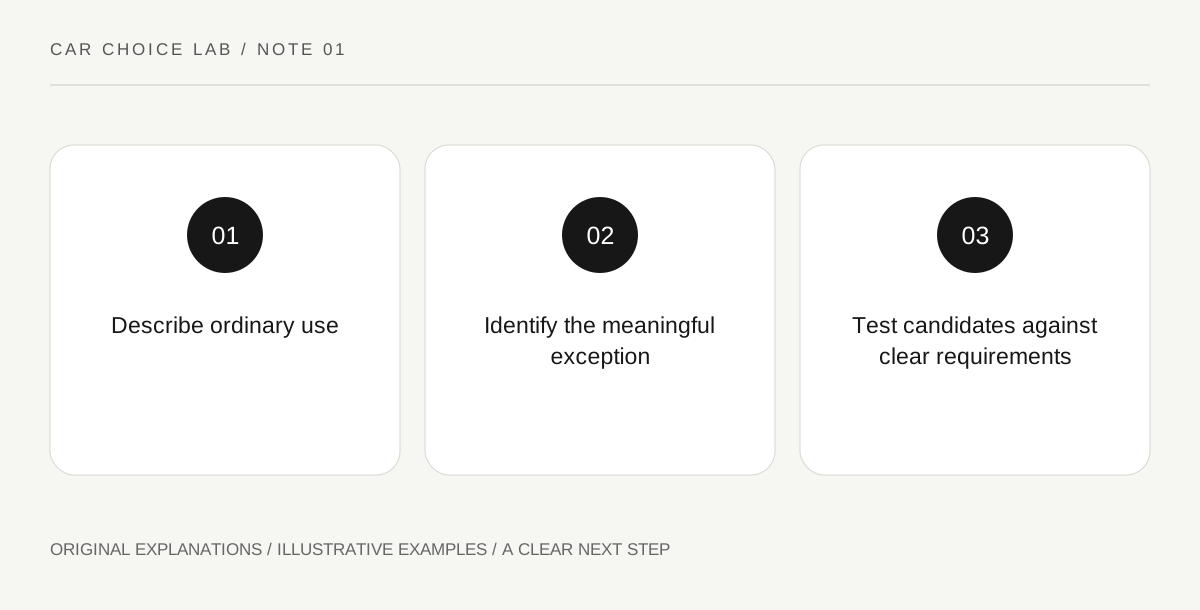
Original explanatory diagram. Read the full method and limitations below.
Describe the normal week concretely
List the journeys you make regularly, including distance, road type, passengers and what travels with you. A short urban commute, a school run and a long rural route create different needs. Keep actual experience separate from a future possibility. Consumer.gov encourages considering the vehicle's broader cost, so include parking, insurance and energy in the practical picture. Do not choose a vehicle category solely from a lifestyle label such as adventurous or family-friendly. Write what the car must do in plain language. A clear brief can be short while still revealing that a large cargo area or a difficult parking footprint has daily consequences.
Use one ordinary weekday as a worked example rather than listing every conceivable feature. Write the departure point, parking, people and load at each stage. A school pickup after work may mean the same car must carry work equipment and passengers together. That simultaneous use can be more revealing than separate idealized scenarios. Keep the example representative and revise it when a genuine life change occurs, rather than after every new vehicle advertisement.
Identify the exceptional trip that matters
Consider the occasional journey that could change the shortlist: transporting a mobility aid, carrying several adults or towing a specific trailer. Describe its real frequency and requirements. Avoid treating every possible future event as a firm need. Ask whether another arrangement could serve a very rare task appropriately and at a known practical cost. This is not a recommendation to rent or borrow in every case; availability, access and safety matter. The purpose is making the tradeoff explicit. A vehicle that serves one annual event may create a larger expense or inconvenience during the rest of the year.
Separate requirements from preferences
A requirement has a concrete consequence if unmet, such as not fitting the permitted parking space or not accommodating necessary passengers. A preference can still matter, but it should not be disguised as a technical necessity. Keep a small list of each. Safety information, access needs and budget deserve their own checks rather than being merged into a single star score. Do not assign precise weights to vague criteria simply to make the decision appear mathematical. A clear explanation of why a feature matters is often more useful than a spreadsheet that gives every attractive option a number.
Use the brief to test real candidates
Compare the exact model year and configuration, not a brand's general reputation. Ask which requirement needs an in-person check, an official specification or a professional assessment. Keep unresolved points visible before a deposit or contract. A vehicle can remain appealing while failing a genuine requirement. Conversely, an ordinary-looking option may fit the job well. Review the brief if circumstances change, but avoid rewriting it after every advertisement. The useful outcome is a shortlist supported by actual tasks and current information, without claiming that one vehicle is universally best or that the brief guarantees satisfaction.
An illustrative weekly brief
A household mostly makes short city trips and has a narrow parking space, but takes one annual holiday with luggage. They define daily parking and passenger needs first, then investigate the holiday load and alternatives. They compare real candidates against those tasks rather than selecting the largest category because it appears more versatile.
Practical checks
Optional checkboxes save only in this browser.
Questions that come up
Should the rarest trip always determine the vehicle?
Not automatically. Consider frequency, alternatives and daily consequences while preserving genuine safety and access needs.
Does this produce one objectively best car?
No. It makes personal tradeoffs clearer. Exact vehicles and circumstances still need verification.
References and scope
These sources support the factual background. Examples and exercises are original illustrative teaching material. References do not imply endorsement.
- Consumer.gov: Buying a Car — Budgeting for a vehicle and considering costs beyond the advertised price.