Check seating, visibility and controls while stationary before the drive
A short showroom sit can miss the interaction between seat position, visibility, pedals and controls. A useful fit check gives each regular driver and passenger a realistic opportunity to use the space. It keeps ordinary comfort separate from a specialist driving assessment or an improvised modification.
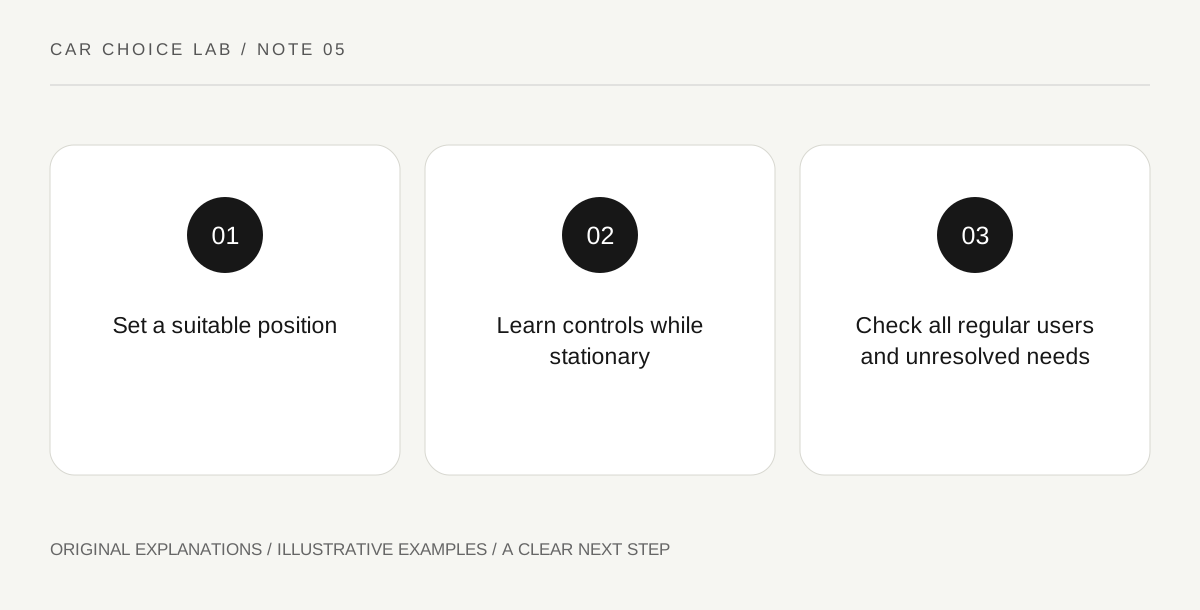
Original explanatory diagram. Read the full method and limitations below.
Set up the driving position as instructed
Ask the seller to explain the seat, steering and mirror adjustments for the exact car, then use the manufacturer's guidance. Check reach and visibility from an appropriate position rather than judging only the seat cushion. Do not move closer to an air bag or alter a restraint contrary to guidance to reach a control. A showroom check cannot determine fitness to drive. NHTSA's adapted-vehicle resources describe specialist evaluation where disability-related equipment or modifications may be needed. If that applies, involve the appropriate professional before buying rather than assuming an accessory will solve the fit later.
Ask each regular user to describe the observation rather than voting on a single comfort score. One may find the door opening difficult while another dislikes a menu layout. Those are different issues, and a larger seat does not solve both. Keep the requirements tied to the person and task. This also helps avoid one confident driver's preference becoming the default for everyone who will enter, ride in or operate the car.
Try ordinary controls while parked
Locate lights, wipers, demisting, hazard lights and other functions you need to understand before moving. Ask how the interface works rather than experimenting in traffic. NHTSA warns that device use can divert attention from driving. A large display is not automatically easier to use, and a physical button is not automatically understandable without a label. Consider whether the controls are legible and reachable for you. Test only permitted stationary functions and keep the vehicle secured appropriately. The aim is learning the interface, not declaring a model universally ergonomic after a few minutes.
Let regular passengers assess their own space
Have willing regular users try entry, exit and seating in the arrangement you actually need. Front-seat settings can change rear space, so keep the driver's position realistic while checking the back. Consider headroom, foot space, door access and the ability to use restraints appropriately. A panoramic roof, third row or seat option may change the exact configuration. Do not rely solely on a published legroom number or a review by someone with different proportions. If child seats are involved, follow the car-seat and vehicle instructions and seek appropriate fitting help rather than improvising a restraint arrangement.
Record the interaction rather than a vague comfort score
Write the specific observation: a control is difficult to reach, the rear door opening is awkward or a passenger's foot space changes with the driver setting. Keep unresolved issues as questions. A cushion, pedal extension or restraint accessory should not be assumed safe because it appears to improve comfort. Seek manufacturer and qualified specialist information when modifications are considered. Use the drive to assess ordinary operation only after the stationary setup is understood. A practical choice works for the people who will use it, without requiring them to accept an unsuitable position because the vehicle has attractive specifications.
An illustrative shared-driver check
Two regular drivers each adjust a shortlisted car while parked and locate essential controls. With the taller driver's realistic setting retained, a passenger checks rear access. The household records a specific reach problem and asks for appropriate advice rather than planning an unapproved accessory after purchase.
Practical checks
Optional checkboxes save only in this browser.
Questions that come up
Can a cushion solve every fit problem?
Do not assume so. Accessories can affect restraints and position. Check manufacturer guidance and seek specialist advice when needed.
Does a comfortable showroom seat prove driving suitability?
No. It is one observation. Driving ability, adaptations and health concerns may need a qualified assessment.
References and scope
These sources support the factual background. Examples and exercises are original illustrative teaching material. References do not imply endorsement.
- NHTSA: Adapted Vehicles — Personal fit and specialist assessment for adaptive driving equipment.
- NHTSA: Distracted Driving — Keeping attention on driving and handling devices before moving.