Plan a test drive around a few ordinary questions, not a performance challenge
A test drive is most useful when it answers questions you can assess safely: visibility, control familiarity, ordinary ride and the route you actually use. It is not a mechanical inspection or a place to provoke driver-assistance systems. A clear plan leaves room to observe without turning the drive into a stressful checklist.
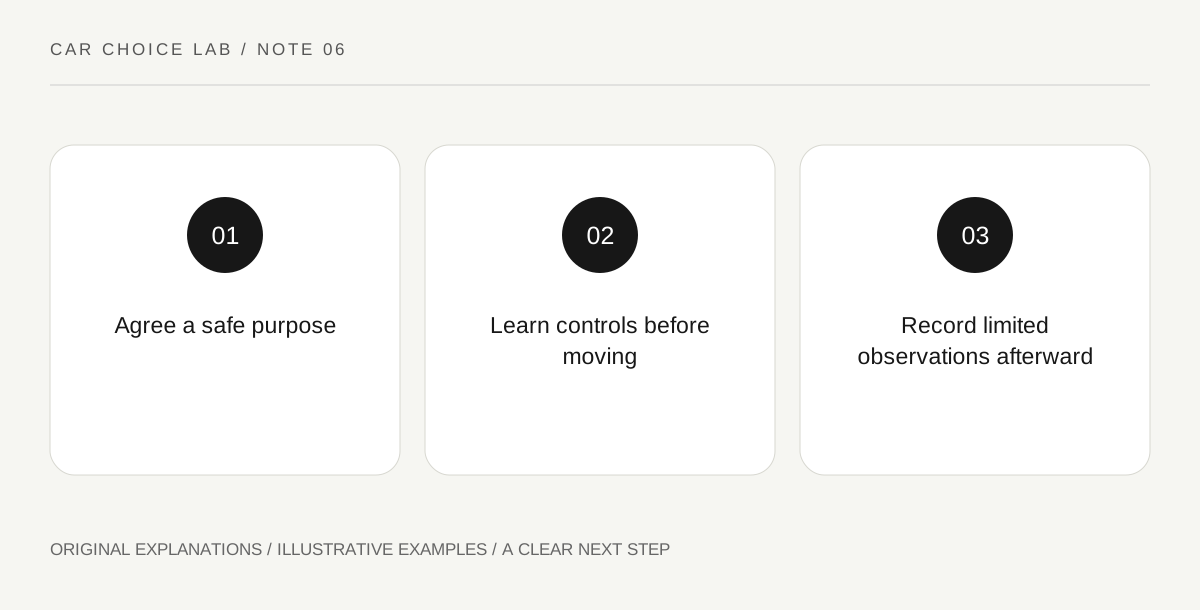
Original explanatory diagram. Read the full method and limitations below.
Confirm permission and practical arrangements
Ask the seller about the route, time, insurance, licence requirements and who may drive. Do not assume permission to take an unfamiliar road or switch drivers mid-route. Choose conditions you can manage safely and postpone if you are unfit to drive. Keep the vehicle identity recorded so observations attach to the correct configuration. A test drive does not establish that another trim with different wheels, seats or powertrain will behave identically. Agree on a few relevant questions before leaving, such as visibility at ordinary junctions or comfort on the type of road you use.
Learn essential functions before moving
While parked and secured appropriately, understand starting, selecting gears, parking, lights, wipers and demisting. Set mirrors and seating according to guidance. Pairing a phone or searching menus should happen before the drive or be left for later. NHTSA emphasizes keeping attention on driving. Ask the representative to explain unfamiliar behavior rather than exploring a screen in traffic. A vehicle's quiet operation or unusual control layout may need acclimatization. If you cannot understand a necessary function, stop safely and clarify. A sales appointment does not justify continuing an uncertain driving task.
Use the same few questions across candidates where conditions permit. A fair comparison does not require an identical road or weather, but it should record meaningful differences. If one drive occurs in heavy traffic and another on a quiet road, note that context before comparing impressions. Do not stretch the permitted route to create a test. A limited observation with honest context is more useful than a confident conclusion drawn from unlike conditions.
Observe ordinary operation within road rules
Use safe legal driving on the agreed route. Notice whether you can see relevant areas, operate familiar functions and maintain a comfortable appropriate position. Do not deliberately trigger emergency braking, lane intervention or traction limits. A system demonstration should not create a hazard. Avoid handling notes or recording devices while driving; make observations afterward or let an authorized passenger note them without distracting you. The drive is a limited sample under specific conditions. Traffic, weather and route can influence the experience, so keep impressions specific rather than converting them into universal performance claims.
Separate impressions from unresolved evidence
After parking, write a few concrete observations and questions. An unfamiliar noise or vibration may need a qualified inspection; do not diagnose it from a short drive. A used car can feel pleasant while still having mechanical or title issues. FTC advice supports independent inspection before purchase. If a second visit is needed to answer an important question, arrange it rather than signing under pressure. The useful outcome is better information about the car's fit and ordinary operation, with clear limits. It is not proof of reliability, a complete safety assessment or a guarantee that the car will suit every future journey.
An illustrative drive plan
Before a permitted drive, Chen learns the essential controls and chooses three questions about ordinary use. He follows the agreed route without testing emergency systems. Afterward he records a specific visibility concern and an unexplained vibration, which he reserves for a qualified inspection rather than diagnosing during the drive.
Practical checks
Optional checkboxes save only in this browser.
Questions that come up
Should I trigger emergency braking to check it?
No. Do not create a hazard. Learn system behavior and limits through appropriate manufacturer information and safe instruction.
Does a pleasant drive replace an inspection?
No. It is a limited experience and cannot establish mechanical condition or title history.
References and scope
These sources support the factual background. Examples and exercises are original illustrative teaching material. References do not imply endorsement.
- NHTSA: Distracted Driving — Keeping attention on driving and handling devices before moving.
- FTC: Buying a Used Car from a Dealer — Buyers Guide, independent inspections, warranties and used-car shopping.
- NHTSA: Driver Assistance Technologies — Warning versus intervention functions and driver responsibility.