Use fuel-economy estimates with your own mileage and price assumptions visible
An official fuel-economy label supports comparison, but its annual cost is based on assumptions that may differ from your driving. A useful review keeps efficiency, distance and fuel price separate. It avoids treating a label's estimated savings as a personal guarantee or comparing different powertrain configurations under one model name.
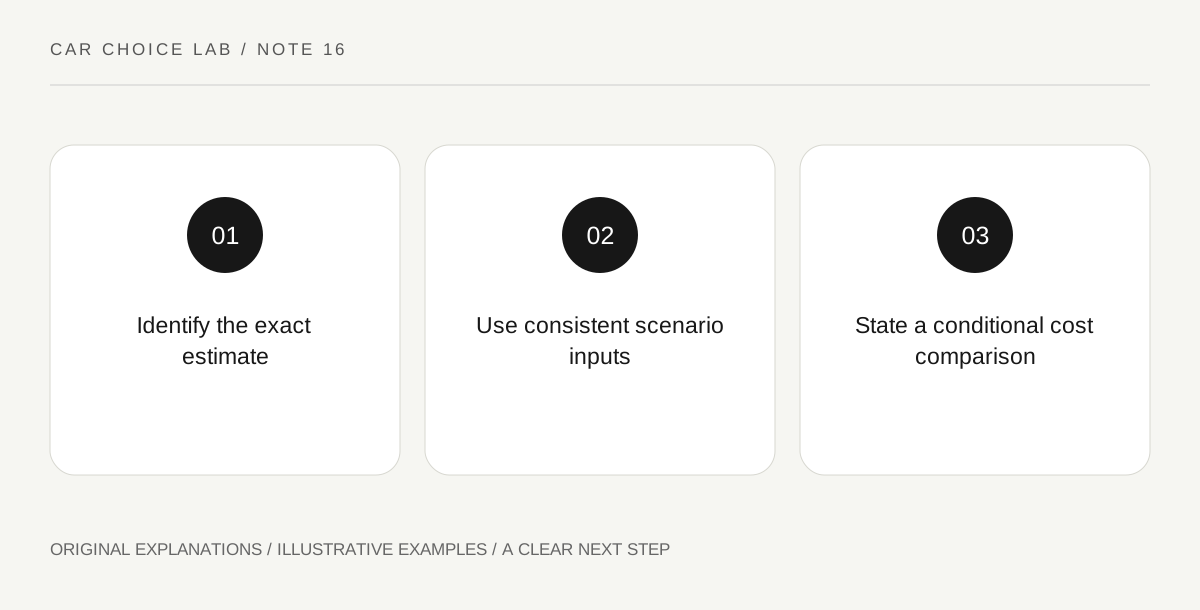
Original explanatory diagram. Read the full method and limitations below.
Match the exact configuration first
Use the model year, engine or motor arrangement, transmission and other configuration details specified by the official comparison. FuelEconomy.gov lets shoppers compare specific versions side by side. A different drivetrain or wheel option may have different information, so do not copy the most favorable figure from a model family. Keep units clear: U.S. miles per gallon differs from other countries' measures, and electric vehicles use additional metrics. The official estimate is a standardized comparison tool, not a prediction of every trip. Your use, conditions and vehicle maintenance can affect actual results.
Read consumption as well as economy
Miles per gallon and fuel used per distance express related information differently. A five-MPG improvement does not save the same amount of fuel at every starting MPG. For an illustrative calculation, 1,000 miles at 25 MPG uses 40 gallons, while at 40 MPG it uses 25 gallons. These invented inputs show the arithmetic, not a forecast for a real car. Use consistent distance and units when comparing. For electric vehicles, read the appropriate energy-consumption measure rather than pretending MPGe is a price. Energy-equivalent efficiency and actual cost are separate questions.
Replace label cost assumptions deliberately
Read the annual mileage and fuel-price assumptions behind the label's estimated cost. If you want a personal scenario, use your own plausible distance and current local price while labeling it as an estimate. Compare more than one reasonable scenario when prices or use are uncertain. Do not include a tax incentive or discount unless current official eligibility for the actual transaction is verified. Keep financing, insurance and maintenance outside the fuel line so savings are not mistaken for the whole ownership outcome. A car can use less fuel and still cost more overall, depending on the complete transaction.
Review uncertainty without false precision
A spreadsheet can calculate many decimal places from uncertain inputs. Round results appropriately and explain what could change them. Use the same assumptions across candidates and keep the source date. Do not promise a payback date from one fuel-price snapshot or a best-case route. If comparing a hybrid, plug-in hybrid and battery-electric vehicle, account for their different operating patterns and charging access. The useful conclusion is conditional: under these assumptions, this energy-cost difference appears. That helps a purchase decision without pretending that an official label or a home calculator guarantees your future spending.
For a cost scenario, write the formula beside the inputs. Gasoline cost over a distance can be estimated as distance divided by MPG, multiplied by price per gallon. That makes the logic inspectable and exposes unit mistakes. The result still depends on uncertain use and prices. A transparent rounded estimate is more useful than a precise-looking annual saving whose mileage or energy price cannot be found.
An illustrative fuel scenario
For a hypothetical 1,000-mile distance, a buyer calculates 40 gallons at 25 MPG and 25 gallons at 40 MPG. She then applies the same illustrative fuel price to both and keeps other ownership costs separate. She does not describe the result as a real model's tested consumption or guaranteed savings.
Practical checks
Optional checkboxes save only in this browser.
Questions that come up
Does the same MPG increase always save equal fuel?
No. Fuel used is distance divided by MPG, so the starting value matters.
Is MPGe an electricity price?
No. It is an energy-equivalent efficiency measure. Actual cost depends on consumption and the electricity price you pay.
References and scope
These sources support the factual background. Examples and exercises are original illustrative teaching material. References do not imply endorsement.
- FuelEconomy.gov: Gasoline Vehicle Label — Fuel-economy label measures, assumptions and estimated costs.
- FuelEconomy.gov: Compare Cars Side by Side — Comparing the exact model-year and powertrain configuration using official estimates.