Compare written out-the-door quotes before discussing a monthly payment
An advertised price can leave important conditions, fees and optional products unresolved. A written out-the-door quote makes the proposed purchase concrete before financing obscures the comparison. The useful task is identifying every line and assumption, not accepting a lower monthly payment as proof that the same car became cheaper.
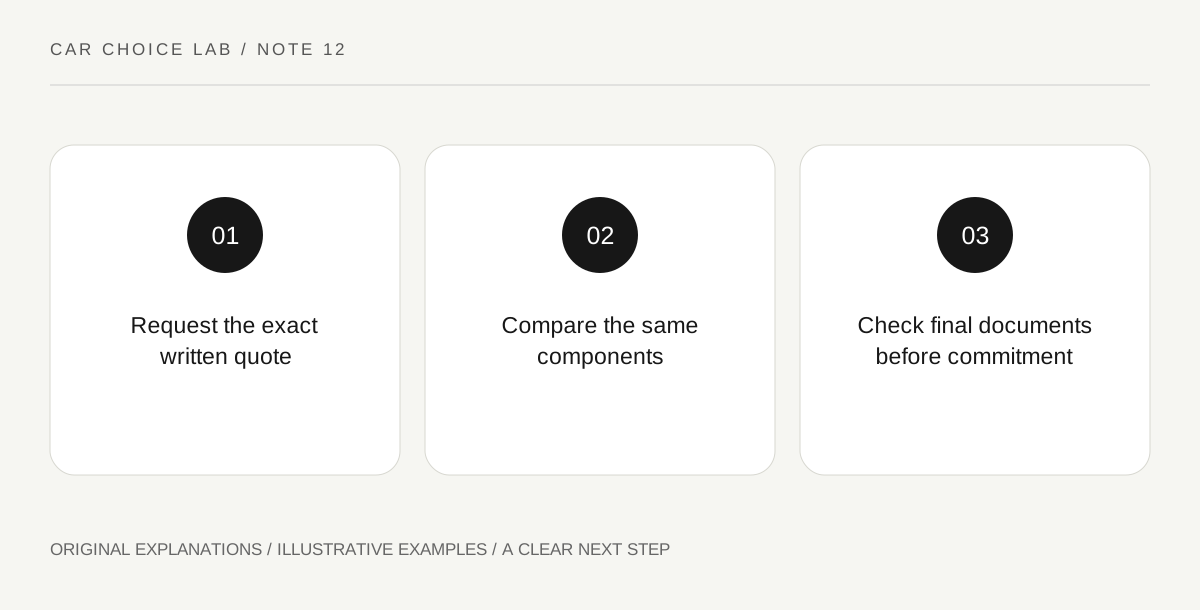
Original explanatory diagram. Read the full method and limitations below.
Tie the quote to the exact vehicle
Record the VIN or another clear stock identity, model year, configuration and included equipment. FTC advice recommends confirming availability and obtaining an out-the-door price in writing before visiting. A quote for an unavailable base version does not price the car you plan to buy. Ask how long the offer applies and which conditions affect it. Keep trade-in and financing assumptions visible rather than allowing them to change the apparent vehicle price silently. If a promotion requires a qualification you do not meet, the headline is not your actual offer.
Read every line as a separate item
Distinguish vehicle price, taxes, government charges, dealer charges and optional products. Ask what each item is and whether it can be declined or changed. The legal treatment of fees varies, so this article does not certify every charge as negotiable or mandatory. Use current local information or qualified advice where needed. A product described as protection may be insurance, a service contract or another item with its own terms. Do not accept an unexplained bundle merely because the total fits a monthly target. A clear quote should let you understand what you would actually purchase.
Make competing quotes comparable
Ask for quotes under the same assumptions where possible, including location-dependent taxes, payment method and optional items. A lower figure excluding tax is not directly comparable with a complete amount. Keep unavailable information labeled rather than inserting a favorable estimate. If a dealer changes the quote because financing or a trade-in changes, ask for a revised written breakdown. You can compare the vehicle transaction separately from borrowing and the disposal of your old car, even when they are eventually completed together. That separation makes it easier to see where a claimed discount is being offset.
Match the final documents before signing
Compare the contract's vehicle identity, price and added products with the agreed written quote. Ask about any discrepancy and do not sign blanks or rely on a promise to correct the total later. Take time to understand the terms and use appropriate professional advice for unresolved legal or financial questions. A deposit, cancellation or return arrangement should also be clear before commitment; do not assume a general cooling-off right. The useful outcome is a reviewable proposed deal with the numbers and conditions visible. It is not a guarantee of the lowest market price or a reason to skip other vehicle checks.
Keep a copy of the quote as received, including conditions and expiry information. If an updated offer replaces it, label the versions rather than editing one number without context. This is particularly useful when a trade-in, financing choice or optional product changes. A clear comparison can show which part moved and why. It does not require accusing the seller of wrongdoing whenever a legitimate assumption changes.
An illustrative quote comparison
Two dealers advertise similar prices, but one written quote includes an optional product and the other omits local charges. The buyer requests comparable complete breakdowns before comparing totals. Financing is reviewed separately, so a lower payment created by a longer term does not hide a higher purchase amount.
Practical checks
Optional checkboxes save only in this browser.
Questions that come up
Does a lower monthly payment mean a lower car price?
No. Term, down payment, rate and other factors can change the payment. Compare the purchase breakdown and financing separately.
Is every dealer fee automatically negotiable?
Rules and circumstances vary. Ask what the charge is and use current local information rather than assuming.
References and scope
These sources support the factual background. Examples and exercises are original illustrative teaching material. References do not imply endorsement.
- FTC: Car Dealer Ads and Promotions — Written out-the-door prices, vehicle availability and advertised conditions.
- FTC: Financing or Leasing a Car — Purchase and lease terms, costs and contract review.