Read a lease against expected mileage, use and end-of-term choices
A lease payment can look attractive while leaving mileage, condition, upfront costs and early-exit terms unresolved. A useful comparison starts with how the car will be used and what the agreement requires at the end. Leasing is a contract choice, not simply buying the same car with a smaller payment.
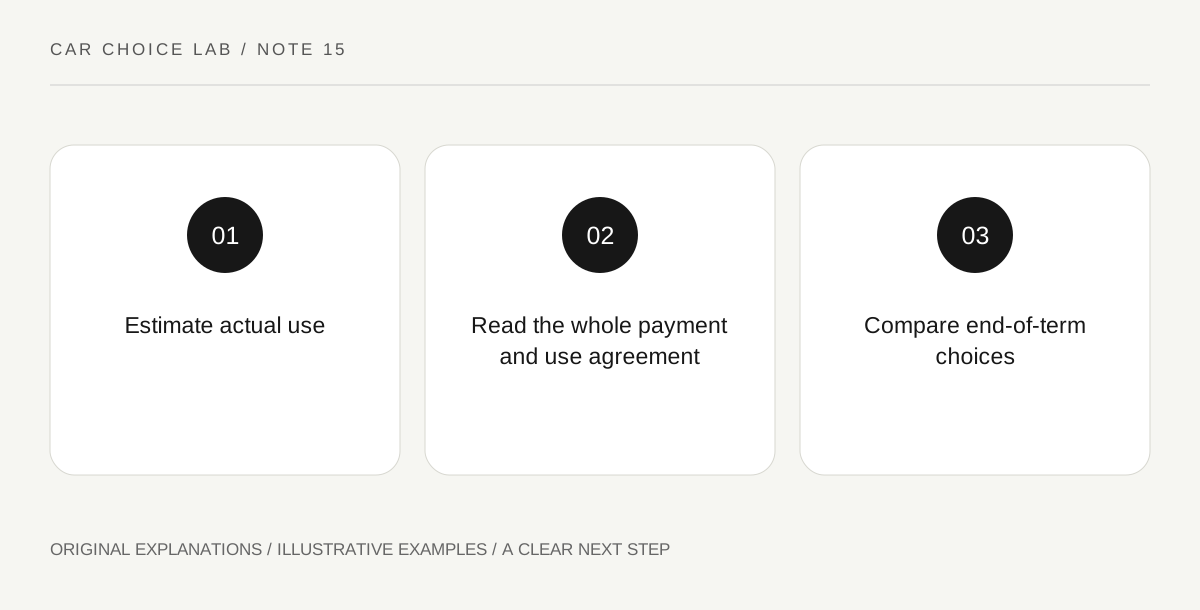
Original explanatory diagram. Read the full method and limitations below.
Estimate use from actual journeys
Review normal travel and likely changes over the proposed term. Include work, family trips and any use the contract may restrict. Keep an ordinary estimate separate from a best-case year. FTC financing and leasing guidance explains that leases can involve mileage limits and other charges. Read the actual allowance and excess-mileage terms rather than relying on a general rule. If work or housing may change, include that uncertainty in the decision. A contract that fits only the lowest possible mileage may create a predictable problem even when the monthly payment looks manageable.
Read the full amount due and payment structure
Identify upfront payments, regular payments, fees and optional products. Ask which amounts are refundable or applied to the agreement and how taxes or other charges are handled locally. A large upfront amount can make the monthly figure look lower without reducing the complete commitment in the way you expect. Do not compare two advertisements using different assumptions as if the payments describe equivalent deals. Request written terms for the exact vehicle. Keep trade-in equity or debt visible rather than allowing it to disappear into an amount due at signing whose components are not explained.
Understand condition and early termination
Read the agreement's wear, maintenance, insurance and return requirements. Ask how condition is assessed and what documentation is available. Do not assume every scratch creates a charge or that every mark is ordinary wear; the actual terms and applicable rules matter. Review early termination and transfer provisions before relying on a plan to exit if circumstances change. A salesperson's casual suggestion that you can always swap later is not a contract guarantee. Seek qualified advice for unclear terms. The point is understanding obligations before the car becomes part of daily life, not predicting every future event perfectly.
Ask how a changed use pattern would be handled before it occurs. A move, new commute or business use may affect practical suitability or contract terms. The answer should come from the actual agreement and provider, not a general statement that leases are flexible. Keep uncertainty in the comparison rather than assuming the cheapest advertised mileage allowance will remain realistic for the entire term.
Compare the end choices and total use cost
Ask about returning, extending or purchasing where those options exist, including how any purchase amount and fees are determined. Do not assume you must or should buy the vehicle at the end. Compare the lease with other suitable options using consistent use assumptions and current written offers. Include insurance, maintenance and other costs not covered. This article does not decide whether leasing is financially best for you. The useful result is an agreement you can explain through the whole term, rather than a payment selected in isolation or a promise that a future trade will remove every consequence.
An illustrative mileage review
A household considers a lease but expects a possible commute change. They estimate both current and plausible higher mileage, read excess-mileage and early-exit terms, and compare complete written costs. They do not treat the advertised payment as the only number or assume a later vehicle swap will be cost-free.
Practical checks
Optional checkboxes save only in this browser.
Questions that come up
Is leasing just a loan with a lower payment?
No. The agreement has different ownership, use and end-of-term features. Read the actual contract.
Can I assume an easy exit if my needs change?
No. Early termination or transfer depends on the agreement and applicable rules. Verify before committing.
References and scope
These sources support the factual background. Examples and exercises are original illustrative teaching material. References do not imply endorsement.
- FTC: Financing or Leasing a Car — Purchase and lease terms, costs and contract review.