Confirm home-charging feasibility before making it the reason to buy an EV
An electric vehicle can fit a routine well when charging access is real and suitable. A parking space near an outlet is only the start of that question. A useful pre-purchase review connects permission, electrical assessment, compatible equipment and the time the car will actually be parked.
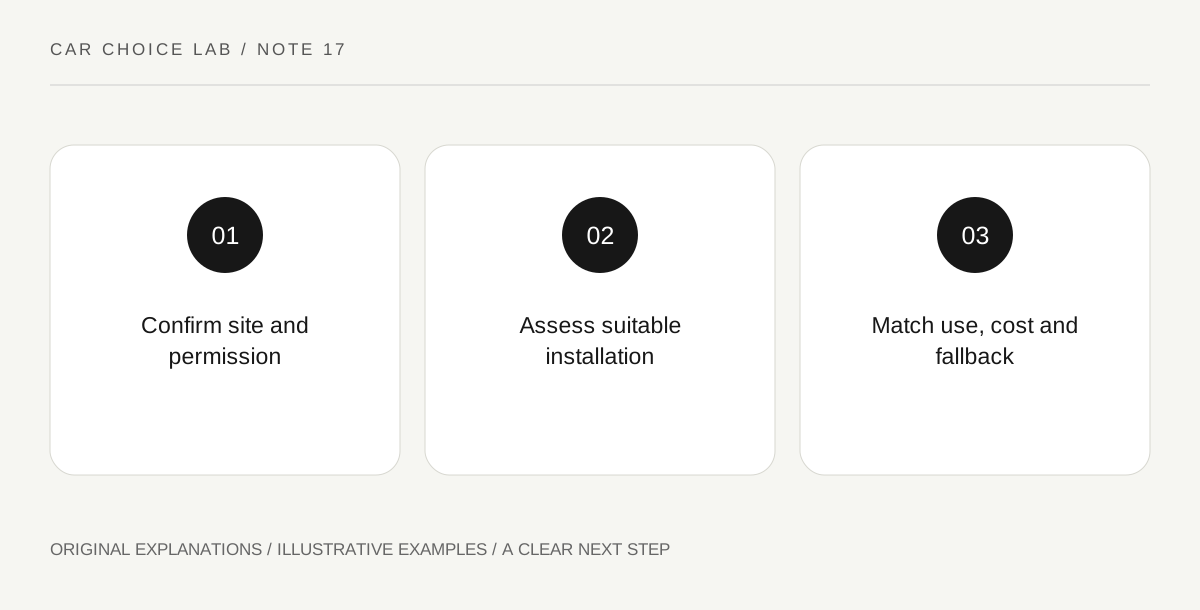
Original explanatory diagram. Read the full method and limitations below.
Define the actual parking and permission
Identify where the car would park, who controls the space and whether installation or regular charging is permitted. A rented bay, shared garage and private driveway have different arrangements. Ask the relevant owner or manager and use current local rules; do not assume a general right or a neighbor's setup applies. DOE's AFDC notes additional considerations for multifamily housing. Keep cable routing and pedestrian access in view without designing the installation yourself. A possible future charger is not the same as confirmed daily access. The purchase comparison should label that uncertainty rather than treating it as a completed feature.
Ask whether an installation quote includes all work needed for the proposed arrangement and how changes discovered on site would be handled. A low equipment price may exclude electrical work, permits or another necessary component. Only qualified assessment can establish the site's requirements. Keep that complete cost alongside the vehicle offer so an unresolved installation does not become an unexpected purchase made after the car is already committed.
Obtain a qualified electrical assessment
AFDC recommends suitable safety-certified equipment and qualified electrical work, with local codes and permits considered. Ask a qualified electrician about the actual site and vehicle needs. This article does not provide wiring instructions or certify an existing outlet. Do not assume an extension lead or an adapter makes a distant outlet suitable. Equipment and circuit requirements depend on the arrangement. Ask for a written scope and estimate when installation is needed, including any relevant permissions. A dealer's general statement that charging at home is easy does not replace a site-specific electrical assessment.
Match charging opportunity to the driving pattern
Consider ordinary distance, irregular shifts, time parked and the vehicle's actual charging capability. Level labels alone do not establish how much energy you will add in your available time. Ask for manufacturer information for the exact car and compatible equipment, and distinguish equipment power from the vehicle's accepted rate. Keep weather and other use conditions in the broader range plan without inventing a universal reduction percentage. A slower appropriate arrangement may fit one household and not another. The useful question is whether the confirmed system serves your pattern, not whether every EV owner needs the fastest home unit.
Include costs and a fallback
Review installation, equipment, electricity tariffs and any recurring charges using current local information. Time-of-use rates can matter, but eligibility and prices need verification. Keep incentives separate until confirmed for the actual purchase and installation. Identify a realistic backup if the home setup is unavailable, including access and compatible public charging. A fallback should be usable rather than a map pin you have never checked. The useful outcome is a charging arrangement with evidence and costs attached. It is not a promise of universal savings or a reason to buy before a crucial permission or electrical question has been resolved.
An illustrative apartment decision
A shopper has an assigned apartment bay but no confirmed charging permission. Before choosing an EV on the assumption of home charging, she asks management and obtains appropriate electrical information. She compares the resulting access and costs with her driving pattern and a realistic fallback instead of treating a nearby outlet as a complete plan.
Practical checks
Optional checkboxes save only in this browser.
Questions that come up
Does an outlet near the car prove charging is suitable?
No. Electrical suitability, equipment, routing and permissions need appropriate assessment.
Should everyone install the fastest available charger?
Not necessarily. The appropriate arrangement depends on the vehicle, site and use pattern. Seek qualified guidance.
References and scope
These sources support the factual background. Examples and exercises are original illustrative teaching material. References do not imply endorsement.
- DOE AFDC: Charging Electric Vehicles at Home — Home charging, electrical assessment, suitable equipment and local installation requirements.