Check public charging by compatibility, access and operation rather than map density
A cluster of charging pins does not establish that a particular EV can use them when and where you need. Connector, adapter approval, network access and operating status all matter. A useful check follows the exact vehicle and current provider information, especially while connector standards and manufacturer access arrangements continue to evolve.
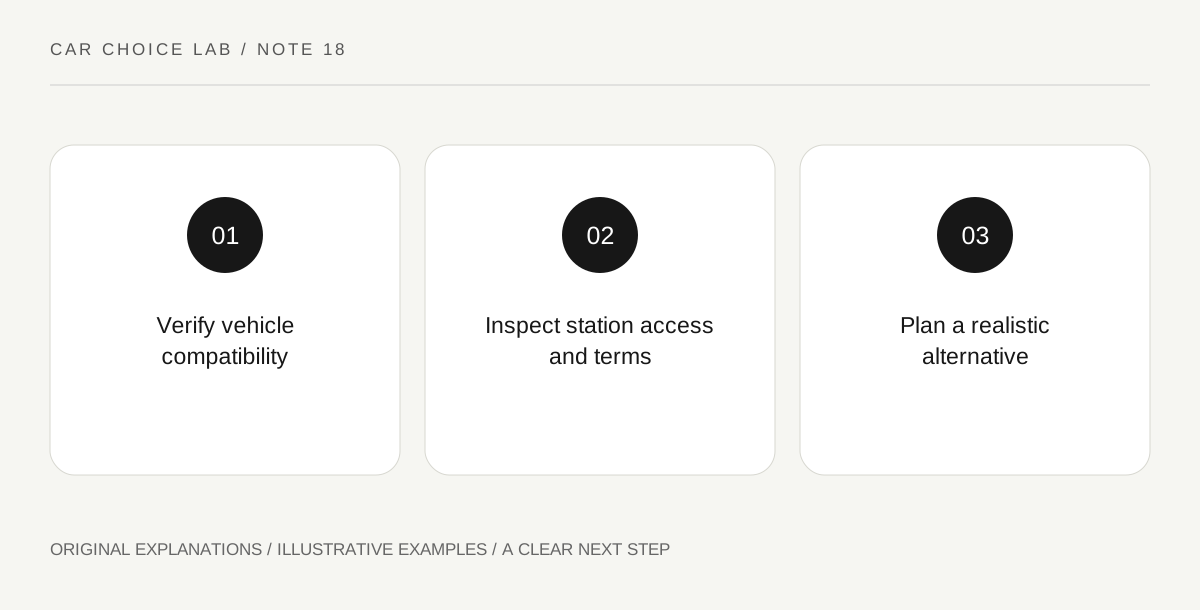
Original explanatory diagram. Read the full method and limitations below.
Start with the actual vehicle's charging capability
Record the model year, charging port and supported charging methods from manufacturer information. The Joint Office's compatibility resources explain that connectors and adapters need careful matching. A physically fitting plug does not establish that every electrical, communication or network requirement is met. Do not assume a friend's adapter or a similarly named model's access applies to yours. Check which adapters the vehicle and charging providers approve and any limits on use. This article does not publish a permanent universal compatibility chart because models, software and network arrangements can change. The exact current documentation matters.
Read the station entry beyond the icon
Check connector type, charging method, public access, opening hours, parking restrictions and payment route. A charger inside a restricted workplace is not an ordinary public fallback. A station may have several connectors but limited simultaneous capacity. Use current operator information and recent status where available, recognizing that conditions can change before arrival. Keep the route and safe stopping options in view. Do not plan an essential journey around one unverified pin or assume a map's distance is the only access issue. The useful unit is a usable charging opportunity, not the raw number of symbols nearby.
Check the physical layout as well as the connector. Cable reach, charge-port location, access needs and parking rules can affect whether a station is practical for the car and user. Do not park unsafely or obstruct another bay to make a cable reach. A compatible station on paper may still need a different location or arrangement. Record those practical observations without turning one successful visit into a guarantee of future availability.
Understand time and cost in context
A station's advertised power is not a guarantee of the rate your vehicle will receive throughout a session. Vehicle capability, battery state, conditions and equipment can affect the experience. Read manufacturer and operator information rather than promising a fixed full-charge time. Check current pricing, possible parking or idle charges and membership terms. Compare the amount of energy and practical time needed for your trip, not an abstract race to a full battery. Keep any illustrative estimate labeled. A public charging routine can be workable while costing or taking longer than a home-based scenario used in an advertisement.
Build a backup you could actually use
Identify another suitable location with compatible equipment and access, and know how to reach it with a sensible margin under the vehicle's guidance. Do not treat the backup as guaranteed operational. Keep necessary accounts or payment methods ready through legitimate provider routes, while protecting account information. Review the plan after actual use and update it when the vehicle or network changes. A practical charging decision includes ordinary inconvenience and uncertainty rather than only best-case demonstrations. The useful purchase conclusion is that your likely routes have a credible current charging arrangement, with limits understood, not that every pin makes every EV interchangeable.
An illustrative route screen
A buyer finds several nearby chargers but learns that one is access-restricted and another lacks approved compatibility for the shortlisted car. She checks current manufacturer and operator information, identifies two suitable alternatives and reviews costs. She does not infer universal access from a connector photograph or an adapter sold online.
Practical checks
Optional checkboxes save only in this browser.
Questions that come up
Does physical connector fit prove compatibility?
No. Approval, vehicle capability and network conditions can also matter. Use current manufacturer and operator information.
Is advertised station power my guaranteed rate?
No. The actual session depends on several vehicle and equipment factors. Avoid a fixed-time promise from the station's headline rating alone.
References and scope
These sources support the factual background. Examples and exercises are original illustrative teaching material. References do not imply endorsement.
- Joint Office: Charging Connector and Adapter Compatibility — Connector and adapter compatibility must be checked for the actual vehicle and charging equipment.